Starburst Program
Dynamic Radio Spectroscopy of Stellar Flares
Starburst Program
Dynamic Radio Spectroscopy of Stellar Flares

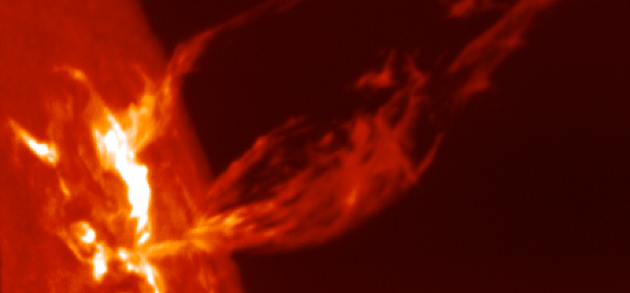
The Starburst Program will use the two 27-meter antennas at the Owens Valley Radio Observatory (OVRO) with a dedicated correlator to produce dynamic radio spectra covering 1 to 6 GHz simultaneously with a 100-ms cadence. Dynamic radio spectroscopy is a powerful tool for studying energy release and plasma conditions in stellar flares and has the potential to detect the signature of coronal mass ejections as they move outwards through the stellar atmosphere.
The Starburst Program is funded by the NSF ATI program and works within the infrastructure of the Expanded Owens Valley Solar Array located at OVRO. Starburst is currently in the development stage, with observations expected to start by fall 2015.
Visit the Background page for an introduction to the science of Starburst.
Starburst team: Gregg Hallinan, Jackie Villadsen, Ryan Monroe, Stephen Bourke, Dale Gary, David Hawkins, Oliver King, Julien Morin, Stephen Muchovej, Tony Readhead, David Woody
Contact: Jackie Villadsen, jrv@astro.caltech.edu
This material is based upon work supported by the National Science Foundation under Grant Number 1311098. Any opinions, findings, and conclusions or recommendations expressed in this material are those of the author(s) and do not necessarily reflect the views of the National Science Foundation.



